
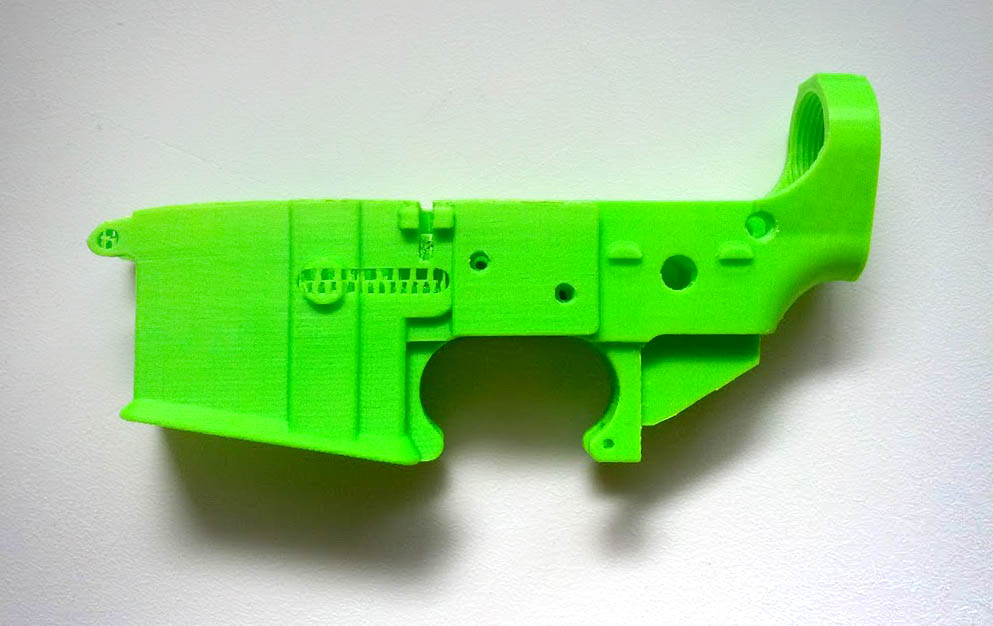
This is the only legally regulated component of the weapon.
It's hard not to like 3D printing. It allows you to transform nearly any 3D form you can draw on the computer into a physical object with a mere push of a button - literally. It also implies a completely alternative way goods might be delivered to consumers, manufactured, or customized to each individual. When your inventory and shipping costs are zero, and your manufacturing volume for any particular model is 1, many traditional assumptions about the economics of manufacturing are no longer valid.
I have no shortage of enthusiasm for that vision. But, there are some significant challenges to overcome before this will become a dominate way people purchase products. So, this transition will not likely occur very quickly. However, I do watch the space of 3D printing and CNC fabrication with fascination, trying to understand where/when it will have dramatic effects on the manufacture of consumer goods. The object pictured above is a startling example, and may have a significant impact on the public discourse of tools like consumer 3D printing.
It is a 3D printed lower receiver for an AR-15 assault rifle based on the original file on Thingiverse. The version I printed is modified so it can print in two pieces on the smaller bed of my printer and has been made intentionally non-functional. But, this person printed one, assembled the full weapon, and successfully tested it with real ammunition. Apparently, fairly little stress is placed on the lower receiver during firing with most of the energy contained by the metal chambers of the upper receiver.
I find this object fascinating.
The lower receiver is the only component of the AR-15 assault rifle that is regulated by federal law as a "gun". If you disassemble a gun, it has many parts. Each part alone is quite harmless, such as the barrel, the grip, the magazine, the shoulder stock. So, which of the many parts actually constitutes the "gun" and is illegal to sell without a license? the lower receiver - which is like the body frame that holds all the parts together. Every other component you can legally purchase online and have mailed directly to your door step, no background check, no registration. But without the lower receiver, the gun would just fall apart and never be able to fire a round. This is the one part that is illegal to sell without a license, should have a serial number on it, and be registered according to local, state, and federal law.
What happens when the one part of the gun that is so intensely regulated, monitored, and the subject of so much national debate and law-enforcement man power, can simply be downloaded off the internet and printed? An individual sitting in front of a computer, can legally order all of the components of an AR-15 (except the lower receiver), order a 3D printer, download a file, push a button, and within a few hours assemble a fully operational unregistered assault rifle in broad daylight without having to resort to illicit or underground suppliers. What happens if they print 10 of them? 100? While it is definitely illegal to sell the parts without a license, the laws regarding home-built weapons for personal use are much less clear and may vary by locality - so, it is your responsibility to check with your local and state laws before you consider printing one of these.
As with any new technology, it can be used for good as well as evil. This is no different here and is not very surprising. However, what fascinates me is that this little piece of plastic, which was so trivial to make using a 3D printer, completely undermines centuries of debate, and fighting, and lobbying surrounding gun control regulation. In my opinion, this a radical example how technology changes faster than our social and political culture can adapt. As the quality of tools like 3D printing gradually mature and become common place and these models are improved, this tension will only increase. These are interesting times.


 Posts
Posts


