
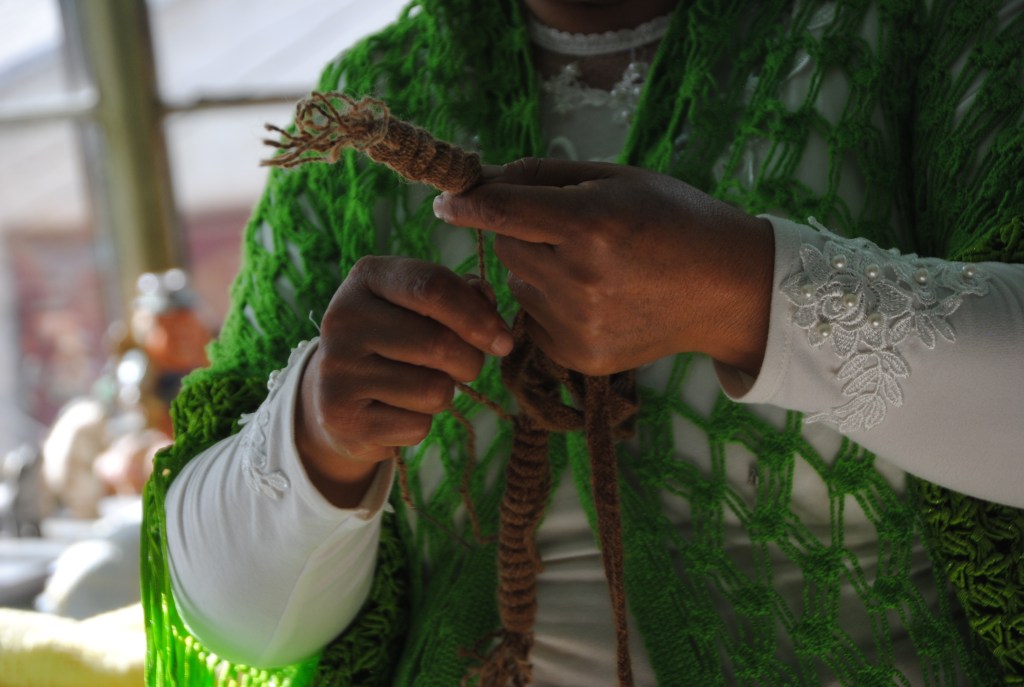
Knowledge and diverse voices are woven together like fabric: intertwined through dialogue. That is why we at Wikimedistas de Bolivia are organizing two conferences on Bolivian Textile and Clothing Cultures as part of the regional WikiFuturo campaign. These events were created with the aim of exploring what has been done and what is currently being done in Bolivia in the field of design, particularly regarding the use of textiles and garment production. At the same time, we seek to open a broader conversation about how we approach fashion and how the social and political context influences design and the trends we adopt in our clothing choices.
On the first day, we revisited the work of Daisy Wende alongside her son, Kenny Wende. During his presentation, Kenny took us on a journey through more than three decades of Daisy’s work, highlighting how political and social changes are reflected in her designs. We were also joined by designer Fátima Molina, founder of Diseñarte, a designer-led design lab that has served as a breeding ground for new talent. This gathering of like-minded perspectives helped us identify how Andean and Indigenous influences continue to permeate fashion in the western part of the country.


Finally, Verónica Avendaño, founder of the digital fashion magazine BOHEM, shared her editorial experience: from preparing photo shoots to working with designers, as well as offering a technical perspective on fashion photography. Her presentation proved particularly valuable, given that a large portion of the audience consisted of photographers. Thus, we wove a narrative thread that offered a brief but meaningful glimpse of design in La Paz, with all its nuances, in the almost idyllic setting of the Flavio Machicado Viscarra Foundation.
This process led to a collective assessment that prompted us to organize a second workshop using a different methodology. This time, we sought to engage directly with the craftspeople who make the garments. To this end, we were joined by Olga Cachi and Marta Apaza, who shared their knowledge of polleras, mantillas, and tullmas—woolen accessories used to secure and adorn braids.


The second day fostered a more fluid dialogue between the presenters and attendees. Our colleague Carlillasa also participated, facilitating the conversation thanks to her prior work with Olga and Marta. During this session, topics such as the processes involved in making the traditional pollera, changes in clothing styles, associated costs, and the reasons behind the transformation of these traditions were discussed. The presenters also noted that this work is not their primary source of income, due to the time and effort involved in hand-sewing.
Daniela shared her career path and reflected on how her training translates into her jewelry work, as well as her transition from printmaking to this field. The conversation allowed for an exploration of her interest in the jewelry worn by women in traditional pollera, the social distinctions between styles such as those associated with “cholita” and “señorita”, and the way these references have influenced her own work.
This is precisely the space we sought to create with this conference: one that allows us to understand not only how we dress or how clothing is designed, but also what lies behind its creation and what meanings it holds, especially in the case of women who wear polleras. How do changing trends manifest in their daily lives? How do they construct their expression of identity and elegance?

Registration for a study on the production of kallawaya textiles by women from the Muñecas province who currently reside in El Alto.
The workshop series represented a departure from the team’s usual work. However, the goal of bringing diverse voices and perspectives to the WikiFuturo campaign was achieved—and even exceeded our expectations. While results typically take time to materialize, we are already seeing encouraging signs: in the photo challenge linked to the workshop series, at least 50% of the participants are new users.
In this way, our contributions to the collective fabric of knowledge continue to take shape, stitch by stitch. We invite you to visit our social media pages to learn more about our work.

Can you help us translate this article?
In order for this article to reach as many people as possible we would like your help. Can you translate this article to get the message out?
Start translation