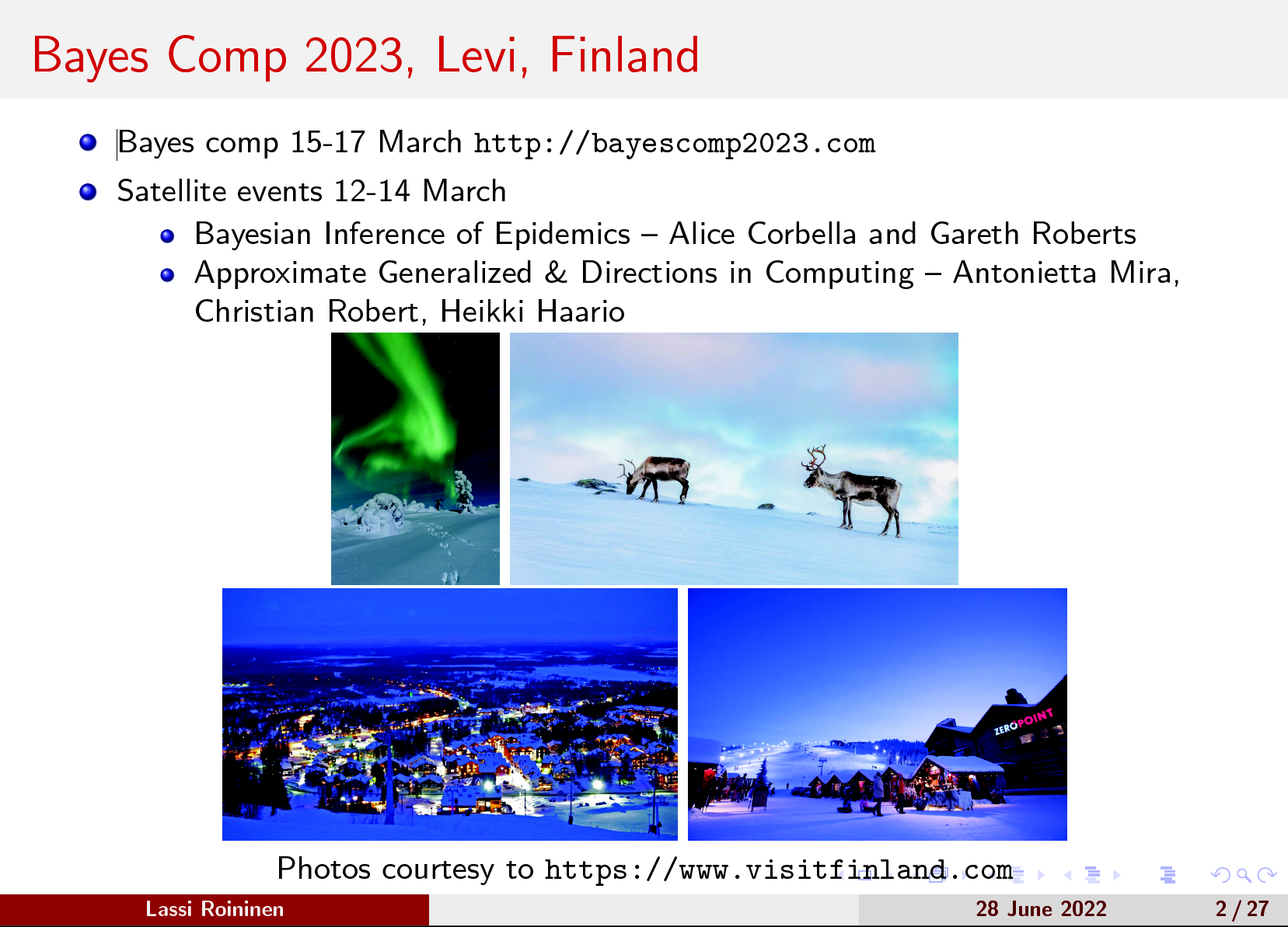
 The main BayesComp meeting started right after the ABC workshop and went on at a grueling pace, and offered a constant conundrum as to which of the four sessions to attend, the more when trying to enjoy some outdoor activity during the lunch breaks. My overall feeling is that it went on too fast, too quickly! Here are some quick and haphazard notes from some of the talks I attended, as for instance the practical parallelisation of an SMC algorithm by Adrien Corenflos, the advances made by Giacommo Zanella on using Bayesian asymptotics to assess robustness of Gibbs samplers to the dimension of the data (although with no assessment of the ensuing time requirements), a nice session on simulated annealing, from black holes to Alps (if the wrong mountain chain for Levi), and the central role of contrastive learning à la Geyer (1994) in the GAN talks of Veronika Rockova and Éric Moulines. Victor Elvira delivered an enthusiastic talk on our massively recycled importance on-going project that we need to complete asap!
While their earlier arXived paper was on my reading list, I was quite excited by Nicolas Chopin’s (along with Mathieu Gerber) work on some quadrature stabilisation that is not QMC (but not too far either), with stratification over the unit cube (after a possible reparameterisation) requiring more evaluations, plus a sort of pulled-by-its-own-bootstrap control variate, but beating regular Monte Carlo in terms of convergence rate and practical precision (if accepting a large simulation budget from the start). A difficulty common to all (?) stratification proposals is that it does not readily applies to highly concentrated functions.
I chaired the lightning talks session, which were 3mn one-slide snapshots about some incoming posters selected by the scientific committee. While I appreciated the entry into the poster session, the more because it was quite crowded and busy, if full of interesting results, and enjoyed the slide solely made of “0.234”, I regret that not all poster presenters were not given the same opportunity (although I am unclear about which format would have permitted this) and that it did not attract more attendees as it took place in parallel with other sessions.
 In a not-solely-ABC session, I appreciated Sirio Legramanti speaking on comparing different distance measures via Rademacher complexity, highlighting that some distances are not robust, incl. for instance some (all?) Wasserstein distances that are not defined for heavy tailed distributions like the Cauchy distribution. And using the mean as a summary statistic in such heavy tail settings comes as an issue, since the distance between simulated and observed means does not decrease in variance with the sample size, with the practical difficulty that the problem is hard to detect on real (misspecified) data since the true distribution behing (if any) is unknown. Would that imply that only intrinsic distances like maximum mean discrepancy or Kolmogorov-Smirnov are the only reasonable choices in misspecified settings?! While, in the ABC session, Jeremiah went back to this role of distances for generalised Bayesian inference, replacing likelihood by scoring rule, and requirement for Monte Carlo approximation (but is approximating an approximation that a terrible thing?!). I also discussed briefly with Alejandra Avalos on her use of pseudo-likelihoods in Ising models, which, while not the original model, is nonetheless a model and therefore to taken as such rather than as approximation.
I also enjoyed Gregor Kastner’s work on Bayesian prediction for a city (Milano) planning agent-based model relying on cell phone activities, which reminded me at a superficial level of a similar exploitation of cell usage in an attraction park in Singapore Steve Fienberg told me about during his last sabbatical in Paris.
In conclusion, an exciting meeting that should have stretched a whole week (or taken place in a less congenial environment!). The call for organising BayesComp 2025 is still open, by the way.
 For the final talk of this Spring season of the One World ABC webinar, we are very glad to welcome Marc Beaumont, a central figure in the development of ABC methods and inference! (And a coauthor of our ABC-PMC paper.)


 Xi'an's Og