Archive for mixed effect models

OWABI@BioInference2025 [29 May]

Posted in Mountains, Statistics, Travel, University life with tags , , , , , , , , , , , , , , on May 13, 2025 by xi'an

The next OWABI webinar is going to be quite special, consisting of two selected talks livestreamed from BioInference 2025, a conference on mathematical modelling and inference on (broadly speaking) biological system, taking place in Bardonecchia, Piedmont. The talks will take place on 29 May, 11am CEST (10am BST). The talks will be streamed on the OWABI MS Team Channel as usual.

1st OWABI Talk: 10-10.30am UK time

Speaker: Andrew Golightly (Durham University)

Title: Accelerating Bayesian inference for stochastic epidemic models using incidence data

Abstract: This work considers the case of performing Bayesian inference for stochastic epidemic compartment models, using incomplete time course data consisting of incidence counts that are either the number of new infections or removals in time intervals of fixed length. The most natural Markov jump process representation of the model is eschewed for reasons of computational efficiency, and replaced by a stochastic differential equation representation. This is further approximated to give a tractable Gaussian process, that is, the linear noise approximation (LNA). Unless the observation model linking the LNA to data is both linear and Gaussian, the observed data likelihood remains intractable. Unlike previous approaches that use the LNA in this setting, two approaches for marginalising over the latent process are considered: a correlated pseudo-marginal method and analytic marginalisation via a Gaussian approximation of the noise model. These approaches are compared using synthetic data with the best performing method applied to real data consisting of removal incidence of Oak Processionary moth nests in Richmond Park, London.

2nd OWABI Talk: 10.30-11am

Speaker: Henrik Häggström (Chalmers University)

Title: Simulation-based inference for stochastic nonlinear mixed-effects models with applications in systems biology

Abstract: We propose a novel methodology for Bayesian inference in hierarchical mixed-effects models. By building on our work, we construct a simulation-based inference (SBI) framework that is highly scalable, where amortized approximations to the likelihood and the parameters posterior are first obtained, and these are rapidly refined for each individual dataset, to ultimately approximate the parameters posterior across many individuals. Unlike the current state-of-art SBI methods, which use neural networks, our approximations are expressed via Gaussian mixture models, leading to easily trainable, parsimonious yet expressive surrogate models of both the likelihood function and the posterior distribution. The methodology is exemplified via stochastic differential equation mixed-effects models to describe translation kinetics after mRNA transfection, however the methodology is general and can accommodate other types of stochastic and deterministic models. We compare our approximate inference with exact pseudomarginal inference and show that our methodology is fast and competitive.

cost(s) of living

Posted in Kids, pictures, Travel, University life with tags , , , , , , , on March 4, 2021 by xi'an

Yesterday, Andrew posted an announcement for a postdoc position in Paris, at the national medical research institute (INSERM) on Bayesian approaches to high throughput genetic analyses using nonlinear mixed effect models and the comments went ballistic about the low salary attached to this postdoctoral position, namely 2600€ – 3000€. As I have already commented on the rather stale clichés on French academics, let me briefly reflect on the limitations of comparing 3000€ a month in Paris with say $5000 a month in New York City. (Which seems to be at the high end of US postdoc salaries.) First, the posted salaries are “gross” but the French one already excludes the 25% taxes paid by the employer. I do not know if this is the case in the US. Second, comparing absolute values makes little sense imho. Even if the purchasing power parity is about one between France and the US, I think the long term cost of living [as opposed to visiting for a week] is lower here than there. If only because the amount is similar to, if higher than, the starting academic salaries and around the median salary. Interestingly, the same appears to be true for the US, if less favourably for the postdocs there.

approximate likelihood perspective on ABC

Posted in Books, Statistics, University life with tags , , , , , , , , , , , , , , on December 20, 2018 by xi'an

George Karabatsos and Fabrizio Leisen have recently published in Statistics Surveys a fairly complete survey on ABC methods [which earlier arXival I had missed]. Listing within an extensive bibliography of 20 pages some twenty-plus earlier reviews on ABC (with further ones in applied domains)!

“(…) any ABC method (algorithm) can be categorized as either (1) rejection-, (2) kernel-, and (3) coupled ABC; and (4) synthetic-, (5) empirical- and (6) bootstrap-likelihood methods; and can be combined with classical MC or VI algorithms [and] all 22 reviews of ABC methods have covered rejection and kernel ABC methods, but only three covered synthetic likelihood, one reviewed the empirical likelihood, and none have reviewed coupled ABC and bootstrap likelihood methods.”

The motivation for using approximate likelihood methods is provided by the examples of g-and-k distributions, although the likelihood can be efficiently derived by numerical means, as shown by Pierre Jacob‘s winference package, of mixed effect linear models, although a completion by the mixed effects themselves is available for Gibbs sampling as in Zeger and Karim (1991), and of the hidden Potts model, which we covered by pre-processing in our 2015 paper with Matt Moores, Chris Drovandi, Kerrie Mengersen. The paper produces a general representation of the approximate likelihood that covers the algorithms listed above as through the table below (where t(.) denotes the summary statistic):

The table looks a wee bit challenging simply because the review includes the synthetic likelihood approach of Wood (2010), which figured preeminently in the 2012 Read Paper discussion but opens the door to all kinds of approximations of the likelihood function, including variational Bayes and non-parametric versions. After a description of the above versions (including a rather ignored coupled version) and the special issue of ABC model choice,  the authors expand on the difficulties with running ABC, from multiple tuning issues, to the genuine curse of dimensionality in the parameter (with unnecessary remarks on low-dimension sufficient statistics since they are almost surely inexistent in most realistic settings), to the mis-specified case (on which we are currently working with David Frazier and Judith Rousseau). To conclude, an worthwhile update on ABC and on the side a funny typo from the reference list!

Li, W. and Fearnhead, P. (2018, in press). On the asymptotic efficiency
of approximate Bayesian computation estimators. Biometrika na na-na.

Bangalore workshop [ಬೆಂಗಳೂರು ಕಾರ್ಯಾಗಾರ] and new book

Posted in Books, pictures, R, Statistics, Travel, University life with tags , , , , , , , , , , , , on August 13, 2014 by xi'an

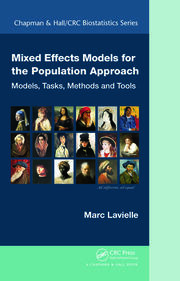
IIScOn the last day of the IFCAM workshop in Bangalore, Marc Lavielle from INRIA presented a talk on mixed effects where he illustrated his original computer language Monolix. And mentioned that his CRC Press book on Mixed Effects Models for the Population Approach was out! (Appropriately listed as out on a 14th of July on amazon!) He actually demonstrated the abilities of Monolix live and on diabets data provided by an earlier speaker from Kolkata, which was a perfect way to start initiating a collaboration! Nice cover (which is all I saw from the book at this stage!) that maybe will induce candidates to write a review for CHANCE. Estimation of those mixed effect models relies on stochastic EM algorithms developed by Marc Lavielle and Éric Moulines in the 90’s, as well as MCMC methods.

Computing evidence

Posted in Books, R, Statistics with tags , , , , , , , , , , on November 29, 2010 by xi'an

The book Random effects and latent variable model selection, edited by David Dunson in 2008 as a Springer Lecture Note. contains several chapters dealing with evidence approximation in mixed effect models. (Incidentally, I would be interested in the story behind the  Lecture Note as I found no explanation in the backcover or in the preface. Some chapters but not all refer to a SAMSI workshop on model uncertainty…) The final chapter written by Joyee Ghosh and David Dunson (similar to a corresponding paper in JCGS) contains in particular the interesting identity that the Bayes factor opposing model h to model h-1 can be unbiasedly approximated by (the average of the terms)

\dfrac{f(x|\theta_{i,h},\mathfrak{M}=h-1)}{f(x|\theta_{i,h},\mathfrak{M}=h)}

when

  • \mathfrak{M} is the model index,
  • the \theta_{i,h}‘s are simulated from the posterior under model h,
  • the model \mathfrak{M}=h-1 only considers the h-1 first components of \theta_{i,h},
  • the prior under model h-1 is the projection of the prior under model h. (Note that this marginalisation is not the projection used in Bayesian Core.)

Continue reading