Archive for NIH

Nature’s menu [12 March 2026]

Posted in Kids, pictures with tags , , , , , , , , , , , , , , , , , , , , , , on March 26, 2026 by xi'an


In this issue with a nutrition highlight, some recommendations for healthier options, not particularly surprising:

  • Morning coffee seems best for heart health“, based on a large longitudinal US study, even though “relationship between coffee consumption and health is unclear”, and especially since this does not impact all-day coffee (and tea?) drinkers.
  • Go vegan for the gut microbiome“, again based on a relatively large metagenomics study (in the US, the UK, and Italy). Omnivorous get the most diverse microbiomes, but red-meat eaters produce some species linked with IBD and cancers, while vegans host more beneficial bacteria with anti-inflammatory impact. Dairy eaters are also (unsurprisingly) associated with healthier microbiomes. And a connected article in this volume on how changes in the microorganisms in the guts contribute to cognitive decline.
  • The quest for proteins“, associating the hormone FGF21 as an endocrine signal of protein deprivation, and hence justifying our craving for protein-loaded food. Without concluding at its health consequences.
  • Sugar rationing reduced diabetes and high blood pressure“, really?! Reminiscing of the post-war (WWII) years in the UK when sugar was rationed. And surveying people born before and after the rationing about their diabetes and hypertension patterns. (Guess what?!)
  • Ditch the fries, not the mash” as a recommendation to eat potatoes despite the high sugar content of this starchy root (which I very rarely consume, even less in the fried format!). Again based on a huge longitudinal study of 5.2 million people years! The conclusion is still that “replacing total potatoes (…) with whole grains was associated with a lower risk of [type 2 diabetes],”

And a shorter list of recommendations for skin care, away from influencers! Like applying sunscreen, eating a nutrient-dense diet, using a simple, well-balanced moisturizer. Apart from these servings, a continuation of themes met in previous issues

  • an editorial on the three recipients of the 2026 Sony Women in Technology Award with Nature, as part of a series of remarkable women scientists, on the occasion of the International Women’s Day, Xiwen Gong at the University of Michigan, Ellen Roche at the Massachusetts Institute of Technology, and Zhen Xu at the University of Michigan, with a rather un-international location
  • yet another tribune on Epstein!, calling for stricter rules on private funding of research,
  • and yet another on stopping the use of AI in war, which has about as much chance to be heeded as a call to stop the wars (alas!),
  • two further wishful opinion articles calling for action against Trump 2.0, with lots of must and can, but little consideration for the negligence of the rule of law by Agent Orange and his administration…

And an article on how Pokémons inspired future scientists, especially those involved in collecting and classifying.

lost science

Posted in Books, pictures, Statistics, Travel, University life with tags , , , , , , , , , , , , , , , , , , , , , , , , on February 22, 2026 by xi'an

The on-going Orange chainsaw massacre on US science is taking a significant chunk of 22 Jan issue of Nature. With prognosis for 2026, and more of the same, special maps on quantifying the impact of 2025 Federal cuts, scientists reflecting on disrupted careers and best ways of fighting back. Plus a book review of The Great Global Transformation by Branko Milanovic (to appear), which explores how globalization and the rise of new elites has induced a parallel growth in nationalism and greed. Which strongly correlates with the Orange disaster. (As a funny aside, both the authors of Why China Will not Rule the World and of When China Rules the World are quoted for their positive reviews!)

On the 2026 US budget prospects, the battle between the Trump administration and the US Congress will a.s. (hopefully!) continue, incl. the cuts to indirect costs, the politisation of grant panels, the drop in foreign student applications and conference attendees. The maps are making much more sense through Nature interactive page than on paper. Since the Mondrian-like maps that represent grant cuts and cancellations according to state, funding source (NIH, NSF—from which direction our Ottawa U friend Panchanathan resigned last April), court reinstatement, and topics. Still, the dynamic change of colours and the lack of scale make these poor or even terrible graphs. Over-optimistic scientists consider reimagining higher education towards public needs (to be distinguished from populist and conspirationist calls on which ground?!), turning to philanthropic support (with highly uncertain long-term prospects, seeing how quickly high-tech moguls turned their jackets under Orange pressure!), and the remaining entries are just wistful thinking… The UCS (Union of Concerned Scientists) is reported documenting 536 attacks of the Trump administration on science and scientific integrity, not counting harassment and intimidation, but this pales against the several thousand federal scientists who have fired and the remaining ones who (still) work in federal agencies under several swords of Damocles, from abruptly cut funding, to newly prohibited domains of research, like health disparities and sexual diseases, to firing, and to visa cancellation… Not a comforting read, this 22 Jan issue of Nature, when realising how massive, deep, long-term-impacting, the havoc the Trump administration has wreaked (or wrought!) on science as much as economy and international relations.

Nature tidbits [06 Nov 2025]

Posted in Books, Kids, pictures, Travel with tags , , , , , , , , , , , , , , , , , , , , , , , , , , , , , , , , , , , , , , , , , , on January 3, 2026 by xi'an

In this issue of Nature (I read on my way to Warwick), a pre-COP30 tribune, to be opposed to later issues!, with a positive take on the impact of the Trump Administration ignoring the conference, with the advances made by China and India (with a surprising 50% of “installed electricity generation capacity coming from non-fossil sources”, if more critical on Brazil’s efforts than the subsequent tribune by the Brazilian undersecretary for ecological transformation for environment, plus a tribune on the ambiguous terms used by countries to secure access to “critical” minerals, in tune with the on-going muscle-flexing attitudes of China and the US. Although the comment is more focussing on the universal access to minerals than to the protection of the workers extracting it and to the environmental impact of it. Followed though by another comment on the climate impact(s) on mining as (no longer) extreme weather events hinder mining all over the (mining) world.

A reflection on China’s 5y plan for science and its reaching a $500 billion annual investment in R&D, predicting (with a large confidence margin) that it will become the #1 power in sciences and technology in the coming decade. I am actually surprised that China has not yet achieved this goal for semi-conductors. And a tribune on the mixed signal of Takaichi Sanae becoming Japan’s first female prime minister, for science as a whole and for gender equity. (My take being that her having UK’s first female prime minister, Margaret Thatcher, as a role-model is not particularly promising. Just like the projection of Marine Le Pen on the verge of becoming France’s first female president does not carry any optimistic message!)

A light entry on a chemical analysis of the specifics of koti luwak (or civet coffee) that does not tell much, beside civet  digestion  adding caprylic and capric acids making beans lower in proteïns and higher in fat. Not yet reaching the goal of “leaving the animals out” from producing this luxury coffee ($75 a cup!).

An article on the shrinking number of US PhD admissions (in some colleges) conflicting with another article in a later issue of a stable influx. And a rather shallow article on the creativity or lack thereof of AI, along with the high sycophancy of LLMs,  to be opposed to a thoughtful reflection on how AI is radically changing the PhD experience and focus, if almost shelving statistics as a thing from the past! But insisting on graduates keeping their ability to check for the validity of their (AI’s)  statistical conclusions!! And another entry on the systematic dismantling of US federal scientific agencies like EPA, CDC, NASA, NOOA, NIH, &tc., by Trump -2.0, which beyond terminating staff contracts in huge proportions is culling the independence of these agencies. With generational impacts on science, training, and evidence-based policies.

A Where I work column featuring a pangolin treated by a Singapore vet, Charlene Yeong. (Unfortunately said pangolin was euthanised after the surgical intervention.) And a book review on the background and motivations of Francis Crick,  just prior to his collaborator James Watson passing away. As noted by the author, Cobb, as MRC staff and later non-resident fellow of the Salk Institute for Biological Studies in San Diego,  “Crick never had to teach or grapple with university administration: he applied for a grant only once in his life.” And concludes that he was not a saint or a hero but “an extraordinarily clever man with limits to his interests and perception”.

make eugenics great again?!

Posted in Books, Kids, pictures, Statistics with tags , , , , , , , , , , , , , , , , , , , , , , , on May 26, 2025 by xi'an

A most interesting (and ghastly) article in The Guardian by Portland writer Derek Beres on “Maga’s era of ‘soft eugenics’: let the weak get sick, help the clever breed“. It points out how significantly the Trump administration is influenced by (soft and not that soft) eugenics ideas. Starting with (the US Secretary of Health) Robert F Kennedy Jr’s MAHA (“make America healthy again”) movement that centres on “natural” selection of the fittest and healthiest members of the community, from his anti-vax positions to his insistence on health being a personal responsibility, to his denying the genetic roots of autism (or letting those impacted disappear from the gene pool), and to stopping NIH funding of research on HIV, vaccine hesitancy,  vaccination rate disparities, and COVID-19, all pointers to this selection by (at best) passivity from the State.

Similarly, Elon Musk’s and Trump’s fascination with IQ tests and levels need not much arguing towards eugenism when recalling that IQ was intrinsically linked with eugenism (as for instance setting the IQ bar in many US States forced sterilisation programs that ran till the 1980’s). Same for the current natalist discourse that mimics the one of the earliest eugenists like Galton, Pearson and Fisher. Trump’s proposal of a baby bonus echoes 1930’s Fisher’s call for an allowance so “that the standard of living of the competent will rise, and that of the incompetent will fall”. And the defunding of USAid, Head Start, HHS and other programs that contribute to children health, nationally or internationally, follows the same furrow that the resulting (numerous) deaths and diseases will only impact the “unfit” part of their Brave New World.

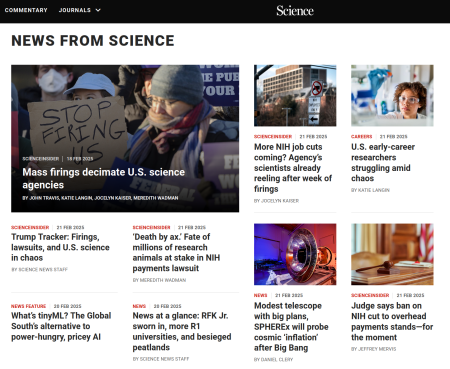
mass decimation of U.S. science

Posted in Statistics with tags , , , , , , , , , , , , , , , , , , , , on March 14, 2025 by xi'an