 A recent arXival on a new version of ABC based on kernel estimators (but one could argue that all ABC versions are based on kernel estimators, one way or another.) In this ABC-CDE version, Izbicki, Lee and Pospisilz [from CMU, hence the picture!] argue that past attempts failed to exploit the full advantages of kernel methods, including the 2016 ABCDE method (from Edinburgh) briefly covered on this blog. (As an aside, CDE stands for conditional density estimation.) They also criticise these attempts at selecting summary statistics and hence failing in sufficiency, which seems a non-issue to me, as already discussed numerous times on the ‘Og. One point of particular interest in the long list of drawbacks found in the paper is the inability to compare several estimates of the posterior density, since this is not directly ingrained in the Bayesian construct. Unless one moves to higher ground by calling for Bayesian non-parametrics within the ABC algorithm, a perspective which I am not aware has been pursued so far…
The selling points of ABC-CDE are that (a) the true focus is on estimating a conditional density at the observable x⁰ rather than everywhere. Hence, rejecting simulations from the reference table if the pseudo-observations are too far from x⁰ (which implies using a relevant distance and/or choosing adequate summary statistics). And then creating a conditional density estimator from this subsample (which makes me wonder at a double use of the data).
The specific density estimation approach adopted for this is called FlexCode and relates to an earlier if recent paper from Izbicki and Lee I did not read. As in many other density estimation approaches, they use an orthonormal basis (including wavelets) in low dimension to estimate the marginal of the posterior for one or a few components of the parameter θ. And noticing that the posterior marginal is a weighted average of the terms in the basis, where the weights are the posterior expectations of the functions themselves. All fine! The next step is to compare [posterior] estimators through an integrated squared error loss that does not integrate the prior or posterior and does not tell much about the quality of the approximation for Bayesian inference in my opinion. It is furthermore approximated by a doubly integrated [over parameter and pseudo-observation] squared error loss, using the ABC(ε) sample from the prior predictive. And the approximation error only depends on the regularity of the error, that is the difference between posterior and approximated posterior. Which strikes me as odd, since the Monte Carlo error should take over but does not appear at all. I am thus unclear as to whether or not the convergence results are that relevant. (A difficulty with this paper is the strong dependence on the earlier one as it keeps referencing one version or another of FlexCode. Without reading the original one, I spotted a mention made of the use of random forests for selecting summary statistics of interest, without detailing the difference with our own ABC random forest papers (for both model selection and estimation). For instance, the remark that “nuisance statistics do not affect the performance of FlexCode-RF much” reproduces what we observed with ABC-RF.
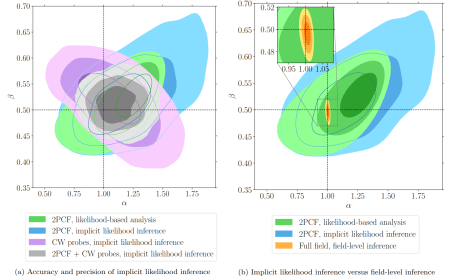
The long experiment section always relates to the most standard rejection ABC algorithm, without accounting for the many alternatives produced in the literature (like Li and Fearnhead, 2018. that uses Beaumont et al’s 2002 scheme, along with importance sampling improvements, or ours). In the case of real cosmological data, used twice, I am uncertain of the comparison as I presume the truth is unknown. Furthermore, from having worked on similar data a dozen years ago, it is unclear why ABC is necessary in such context (although I remember us running a test about ABC in the Paris astrophysics institute once).




 Xi'an's Og