
On 28 October, I spent the day at Institut d’Astrophysique de Paris (where I used to work on PMC for cosmology between 2005 and 2009), as a committee member for the habilitation defence of Florent Leclercq. Not only it was nice to be back in this unique institution (with vestiges from Laplace’s era), but this was a fantastic habilitation, with a superb thesis that beautifully gathered the different fields mastered by the candidate in a highly coherent discourse. And could serve as an introduction to cosmostatistics for many.
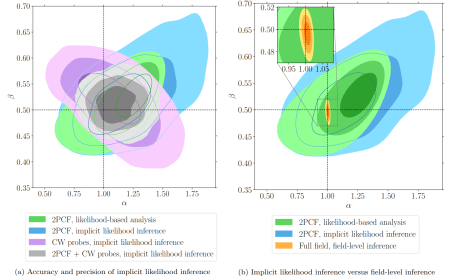
And provided the background to ten years (post-PhD) of research on forward modelling in cosmology and resulting Bayesian statistical analysis either by implicit likelihood (or likelihood-free) inference or by field-level inference. He describes the Simbelmynë software he developed to produce maps of the density field and analyse dark matter dynamics. Ẁhose name is borrowed from Tolkien (along with a quote from Guy Gavriel Kay!):
“How fair are the bright eyes in the grass! Evermind they are called, simbelmynë in this land of Men, for they blossom in all the seasons of the year, and grow where dead men rest.” — J.R.R. Tolkien, The Lord of the Ring
And the Bayesian computational and modelling tools he elaborated, like SELFI (Simulator expansion for likelihood-free inference, Leclercq et al., 2019), that relates to Michael Gutmann’s and Juka Corander’s BOLFI. (Obviously, I did not get every aspect right from just reading the thesis and attending the lecture, in particular the remarks on using SELFI to assess model misspecification. But I remain impressed by the scope of the work and its likely impact on the field!)


 Xi'an's Og