
Archive for Statistics and Computing
“Approximating evidence via bounded harmonic means” is out! [in Statistics and Computing]
Posted in Books, R, Statistics, University life with tags CRAN, ECMLE package, evidence, Gelfand and Dey identity, harmonic mean estimator, HPD region, inverse probability weight, marginal likelihood, paper, PhD students, R function, Statistics and Computing on April 24, 2026 by xi'an
positive response to negative mixtures
Posted in pictures, Running with tags academic publisher, accept-reject algorithm, acceptance, acceptance probability, article, COVID-19, inverse cdf, master project, PSL Research University, publication, signed mixture, simulation, Statistics and Computing, Université Paris Dauphine, ziggurat algorithm on December 17, 2024 by xi'an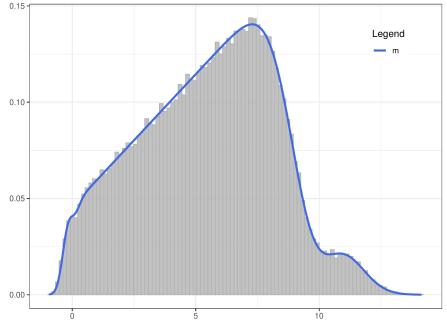 Hurray, our signed mixture simulation paper has been accepted by Statistics & Computing! If Og’s readers remember my earlier post about this problem, things get surprisingly more complicated when the mixture weights can take negative values. For instance, the naïve solution consisting in first simulating from the associated mixture of positive weight components and then using an accept-reject step may prove highly inefficient since the overall probability of acceptance can get arbitrarily close to zero. Substituting to this naïve version, we construct an alternative accept-reject scheme based on pairing positive and negative components as efficiently as possible, partitioning the real line, and finding tighter upper and lower bounds on positive and negative components, respectively, towards yielding a higher acceptance rate on average. In retrospect, the problem was beyond the reach of the undergraduate students we supervised (pre-COVID) on a research internship!
Exact MCMC with differentially private moves
Posted in Statistics with tags data privacy, differential privacy, MCMC, Metropolis-Hastings algorithm, penalty algorithm, private data, pseudo-marginal MCMC, Statistics and Computing on September 25, 2023 by xi'an
“The algorithm can be made differentially private while remaining exact in the sense that its target distribution is the true posterior distribution conditioned on the private data (…) The main contribution of this paper arises from the simple observation that the penalty algorithm has a built-in noise in its calculations which is not desirable in any other context but can be exploited for data privacy.”

Another privacy paper by Yldirim and Ermis (in Statistics and Computing, 2019) on how MCMC can ensure privacy. For free. The original penalty algorithm of Ceperley and Dewing (1999) is a form of Metropolis-Hastings algorithm where the Metropolis-Hastings acceptance probability is replaced with an unbiased estimate (e.g., there exists an unbiased and Normal estimate of the log-acceptance ratio, λ(θ, θ’), whose exponential can be corrected to remain unbiased). In that case, the algorithm remains exact.
“Adding noise to λ(θ, θ) may help with preserving some sort of data privacy in a Bayesian framework where [the posterior], hence λ(θ, θ), depends on the data.”
Rather than being forced into replacing the Metropolis-Hastings acceptance probability with an unbiased estimate as in pseudo-marginal MCMC, the trick here is in replacing λ(θ, θ’) with a Normal perturbation, hence preserving both the target (as shown by Ceperley and Dewing (1999)) and the data privacy, by returning a noisy likelihood ratio. Then, assuming that the difference sensitivity function for the log-likelihood [the maximum difference c(θ, θ’) over pairs of observations of the difference between log-likelihoods at two arbitrary parameter values θ and θ’] is decreasing as a power of the sample size n, the penalty algorithm is differentially private, provided the variance is large enough (in connection with c(θ, θ’)] after a certain number of MCMC iterations. Yldirim and Ermis (2019) show that the setting covers the case of distributed, private, data. even though the efficiency decreases with the number of (protected) data silos. (Another drawback is that the data owners must keep exchanging likelihood ratio estimates.

MCMC, with common misunderstandings
Posted in Books, pictures, R, Statistics, University life with tags ABC, Bayesian computing, computational statistics, Gibbs sampling, Handbook of Computational Statistics and Data Science, HMC, IMS Lawrence D. Brown PhD Student Award, MCMC, PhD thesis, Q&A format, Statistics and Computing, survey, variational Bayes methods on January 27, 2020 by xi'an As I was asked to write a chapter on MCMC methods for an incoming Handbook of Computational Statistics and Data Science, published by Wiley, rather than cautiously declining!, I decided to recycle the answers I wrote on X validated to what I considered to be the most characteristic misunderstandings about MCMC and other computing methods, using as background the introduction produced by Wu Changye in his PhD thesis. Waiting for the opinion of the editors of the Handbook on this Q&A style. The outcome is certainly lighter than other recent surveys like the one we wrote with Peter Green, Krys Latuszinski, and Marcelo Pereyra, for Statistics and Computing, or the one with Victor Elvira, Nick Tawn, and Changye Wu.


 Xi'an's Og